
Human Errors, and Understanding
A Thorough Dissection of Justice (and Injustice), brought to you by "Kind of a Drag"

Some folks have brought to my attention the issue of the length of content I post. Apparently it is preferable that I should post my essays piecemeal, rather than in their entirety, so as to whet everyone’s appetite before the main course. From this point on, I will carry out that process. Without further ado, here is the opening installment of what I expect will be a continuing subject for a good while:
There has always been a soft spot in my heart for innocent people railroaded by overzealous officials who we, as a society have tasked with the duty of upholding and enforcing the law. For as far back as I can remember, I have felt a seething rage against the purveyors of such travesties of justice as wrongful prosecutions and convictions. Sometimes, I have been intemperate in how I express my fury in public settings. During times when I am unmedicated, my wild emotions tend to display themselves, as it is exceedingly tough to contain them while I am daydreaming of the daily torrent of such injustice stories I find on TV and in the newspapers. People next to me, sitting on a bus, or in the library might notice me shaking my fists and flailing my arms in excited animation. My father bore witness to these displays of excitement when he read me The Count of Monte Cristo (junior novelization, of course) at bedtime. Many times has he recounted for me his recollection of my being all fired up listening to Alexandre Dumas’s narrative of the stabbed-in-the-back hero Edmond Dantes’s crafty, well-planned revenge against his three pernicious victimizers in nineteenth century France. How gleeful I was at hearing each of their well-deserved takedowns.
What is it about official corruption in the criminal justice system that has particularly stoked my ire? I’ve had to reflect long and deliberately on this question. I think it has to do with my personal fear of the machinations of such a colossal entity as the system. It is larger and more unwieldy than the individual citizen, and I am knowledgeable of the fact that this type of corruption strikes at persons with many physical and mental weaknesses. As such a person, I am especially vulnerable. The ugly irony of justice miscarried in this fashion is that it can target citizens from all walks of life. I think that most commentators miss the mark when they emphasize race and class as the most contributing causal factor in wrongful convictions. It is not race and class that directly bears responsibility, it is general vulnerability. People who are from racial minority groups and lower socioeconomic backgrounds are more vulnerable to being railroaded. But that does not mean people who have higher privilege are immune, as the many identity-worshipping demagogues (they know who they are) would have us all believe. History bears note of many upper-class victims of legalistic persecution. Leo Frank, the Jewish businessman lynched in the state of Georgia in 1915, following the governor’s commutation of his death sentence for the 1913 rape-murder of the thirteen-year-old pencil factory employee Mary Phagan is a prime example of an innocent man, wrongly convicted and condemned.
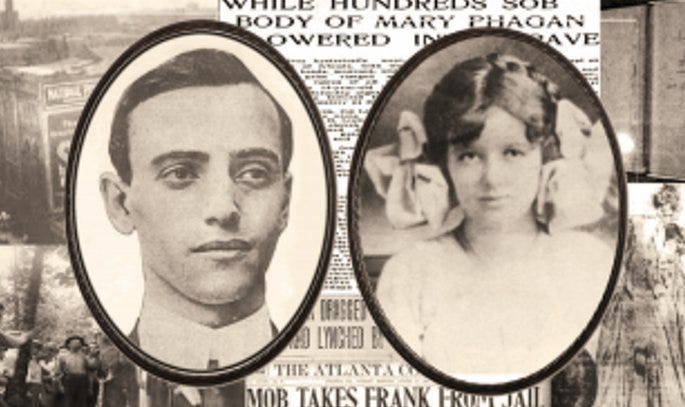
It was not something as simple as an angry mob that committed this barbaric antisemitic-motivated lynching; not some spontaneous flaring of outrage and violence among Atlanta’s non-Jewish majority population. In fact, the perpetrators committed the atrocity with the stealth of a military-like operation with high levels of power in the state sanctioning it. Several of the conspirators included prominent citizens, from the attorney general to the local business and municipal chieftains of the day. They brazenly defied the legally binding order by Governor John M. Slaton (his standing up to massive political pressure was definitely a profile in courage). A handful of them formed a determined posse and broke into the prison facility which housed Leo Frank and abducted him into their custody. The posse then proceeded to “escort” the defenseless factory manager to Mary Phagan’s hometown of Marietta, and hung him from a tree facing the house the poor girl was raised in.
More to come Thursday…
Excellent post.